Gaiman v. McFarlane 2010: Medieval Spawn's Backstory

Saturday, July 3, 2010

Part Twelve [This is part of my running report on the 2010 hearing in the Neil Gaiman v. Todd McFarlane case. To see coverage from the beginning, click here.] Discussing the backstory of Medieval Spawn, Neil Gaiman said, "There isn't a lot of opportunity on those eight pages [in which the character appeared in Spawn #9] for conversation. In my backstory in my head, I think he'd been probably around fighting for ... five or 10 years, but nobody had actually turned around at that point and said, 'This is actually what's going on. You are going to be in Hell's army, blah, blah, blah, blah, blah.' but he had ... still been going around doing a certain amount of good wherever he could and being noble, even though he was a Spawn. I seem to remember some line about how when Spawns were young they could still ... fight for good, and ... in the case of young and fighting for good, I take it that Spawn is still fighting for good 18 years after the comic started. So the print gives you 18 years at least."


Looking at Spawn #9, it may be instructive to look at the total dialogue of Medieval Spawn talking to Angela, written by Gaiman. The speeches were as follows: "Good day, sweet maiden. You are hurt." "Where is this ogre?" "You would not wish to see my face, sweet maiden. Your sister, you say ...? I also had a sister, beautiful and wise, whom I swore I would see married before I died." "I ... went away, for many years. When I returned, my sister was indeed married ... not to the man I would have chosen, alas. If we knew the future, well, what then?" "I no longer have a name." "I also am most strong and fearsome. You shall wait here." "Very well." "No wizard, fair one. Once I was a man ... a bad man ... Now ... I know not what I am. This cave ... How much further must we go?" "What magic is this?" "What ... What manner of creature are you?" and "I don't understand ..." That's the printed material under discussion at this point in the hearing.

Gaiman said, "He's just met her. She's going, 'Ah, I'm a damsel in distress. Something bad is happening there. What are you?' And he said, 'Well, I was a bad man; now, I could be anything.'"

Next

Read more...

Gaiman v. McFarlane 2010: A Traveling Minstrel Spawn?

Part Eleven [This is part of my running report on the 2010 hearing in the Neil Gaiman v. Todd McFarlane case. To see coverage from the beginning, click here.] Todd McFarlane attorney Alex Grimsley showed Neil Gaiman the final page of Spawn #8, written by Alan Moore. "See there at the feet of the devil creature? Can you make out what is gathered at his feet?" Gaiman answered, "Lots of Spawn costumes, probably with people in them." "So a mass of other Hellspawn?" "No, not necessarily," Gaiman said, "These are creatures in Hell. You get one Hellspawn ... every 400 years. These were lots and lots of neural parasites wearing people ... or, at least, that was the way that Alan and I talked it through at the time. ... They're not Spawn. Every 400 years, one of these guys gets tested to be officer material, and the army: Those are the grunts in the army. It's the difference between a general and the troops." Grimsley asked, "So the idea that there was an army of individuals in Hell wearing the neural parasitic suit (or having a neural parasitic suit wear them, if you will) preexisted issue #9?" There ensued a discussion of the timing of comic-book creation in a series, in which Gaiman commented that publication in sequence doesn't necessarily mean creation in sequence. "It's not like Alan writes this issue and then Todd draws it and then I write issue #9 and then Todd draws it."

Grimsley turned to the matter of influences in writing stories. "Sometimes your stories might bear similarities to another story?" "It happens over and over," Gaiman said, "They say there are three different stories you can tell." Grimsley specified Gaiman's fantasy novel American Gods (published in 2001). "You've been asked in the past ... if American Gods was inspired by Eight Days of Luke by Diana Wynne Jones." Eight Days of Luke had been published in 1975. Gaiman responded, "Yes. The answer was no. ... What I actually said was that I came up with a way of telling the story which was going to be naming days of the week after the gods that they are named after and, when I came up with that, I realized that Diana had done something ... similar in Eight Days of Luke. But the plot of American Gods and the plot of Eight Days of Luke bear no relationship to each other, nor do the characters." Grimsley asked whether characters created out of whole cloth could bear "superficial similarities to characters someone else creates." Gaiman replied, "That's always true."
Grimsley posed an example: "If you were to create a caveman character ... you might give him a club as a weapon, right?" Gaiman said, "It's a strange hypothetical. I've never written a caveman that I can think of and I don't think I'd give him a club because it's kind of stupid. I'd probably give him a stone ax, because that's what they used." Grimsely continued, "If someone else used a stone ax for a caveman doesn't mean they derived it from your caveman, right?" Gaiman said, "I would assume not." Grimsley moved on to Medieval Spawn, "You created ... the idea of a knight-in-armor Spawn, right?" Gaiman said, "No. I created the character." Gaiman agreed with Grimsley's identifying Spawn as an "action series," and Grimsley asked, "So Medieval Spawn was going to be a fighting character probably, right?" "I guess." "Not a traveling minstrel, right?"
Gaiman responded, "It could have been a traveling minstrel. That would have been fun to write, too." He added that he'd only had eight pages and didn't think Todd would have wanted to do a minstrel toy, "but we could have gone there." He elaborated, "When you're starting any kind of writing process, you have an infinite number of ways to go. I could not pretend, 17 years later at this point, to reconstruct my thought processes on how I decided it was going to be a knight in armor and why it would have been 800 years ago. ... In a comic called 1602 which I did for Marvel Comics [#1, November 2003 - #8, June 2004] ... I reinvented all of the Marvel characters and set them in the early 17th century, in 1602, and created Daredevil. Marvel's big fighting super-hero was actually a minstrel in it, and I invented him as a blind traveling minstrel. If you're a good writer, you crate characters that live on, that exist, and you don't say, 'Ah, because this is fighting, you can only be this one thing.' That's nonsense."

Next

Read more...

Gaiman v. McFarlane 2010: Spawn Bible and Spawn #8

Part Ten [This is part of my running report on the 2010 hearing in the Neil Gaiman v. Todd McFarlane case. To see coverage from the beginning, click here.] After a 15-minute recess, the hearing continued with Todd McFarlane's attorney Alex Grimsley beginning his cross-examination of Neil Gaiman. Grimsley referred to Spawn Bible (August 1996), whose credits were that the art was pencilled by Greg Capullo and inked by Danny Miki and Kevin Conrad and the entries were written by McFarlane, Beau Smith, Tom Orzechowski, and Andrew Grossberg. He asked Gaiman whether the page devoted to Angela summarized her "drives and personality." Gaiman responded, "The text is an adequate and fairly literate description by somebody else of the plot of Angela - of Spawn #9, and of Angelas #1 to #3. I don't know that I would agree with everything. I didn't write this." Asked whether there were parts with which he disagreed, Gaiman said, "The line 'Angela comes from Elysium, the first level of the Seven Heavens, closest to God' is not, for example, anything that I - You know, I just created Elysium. If Todd wants seven levels, he can add another six. That's fine." Asked whether he claimed co-creation of the idea of seven levels, Gaiman answered, "No. Alan Moore came up with the idea that there was seven levels of Hell in Spawn #8, and ... that was Alan's idea, and I imagine that is a reflection of the same thing done in angel terms." [In Spawn #8, a demon says his home is "the eighth sphere, some call it the Malebolge."] In any case, Gaiman agreed that the Spawn Bible description - though, "I would probably quibble with words all the way through it, but that's because I didn't write it" - was "a perfectly adequate description by somebody of the character in Spawn #9 and Angelas #1 to #3."


The questioning turned to "Medieval Spawn." "Medieval Spawn is another character you co-created?" "Yeah. I call him 'Olden Days Spawn,' I think, in this script, but Todd started calling him 'Medieval Spawn.'" "In the script, you actually think you named him something?" "He was Spawn. He was the Spawn of 800 years ago." Again, Grimsley referred to Spawn Bible, asking whether the "Medieval Spawn" entry was a fair description of the character Gaiman co-created. "It's an invented backstory, I guess," Gaiman said. "It could be - I didn't make any of that up, so that's not my - ... The story that I made up is the stuff right at the end and the stuff about the sister, which doesn't seem to be in there." The portion of description that he said was what he had created was, "... he was destroyed by Angela, without ever fully comprehending what he was." Gaiman said his creation had included providing thumbnails and drawings of the characters but he hadn't drawn any of the published images of the characters. "I described [Angela] in the script, but my co-creator had already had already given her a look." Regarding the Spawn of the Middle Ages, he said his script, "would have said ... it would be a medieval version of the Spawn costume or an armored version of the Spawn costume. I would have included the big Spawn shield, because that was on the cover."

The questioning turned to the issue that preceded Gaiman's: Spawn #8, drawn by McFarlane and written by Alan Moore. And, I discover with some shock, a fact I'd forgotten. It's "Dedicated To: Don & Maggie Thompson." My goodness! I remember now that we'd been touched and delighted at the time. But ... pause for a moment to grin. Then back to the hearing. Sorry for this self-indulgent interlude. Ahem. The story is titled "In Heaven (Everything Is Fine)." Gaiman said, "It's actually set in Hell. That's an ironic title." Grimsley noted the reference to an evolving neural parasite. Gaiman said, "Todd had asked Alan, and he mentioned to me, that he kept drawing the Spawn costume differently because he couldn't ever remember how many chains and spikes there were to be. So he was now getting letters from kids saying that the costume kept changing and could we come up with a rationale for why the costume was changing. So Alan came up with the idea, and I think we were talking about it, that ... the costume was a neural parasite and the costume was alive and it would keep the Spawn costume evolved and changed and responded and it wasn't actually a frozen thing."

Next

Read more...

Gaiman v. McFarlane 2010: Medieval and Dark Ages Spawns

Friday, July 2, 2010

Part Nine [This is part of my running report on the 2010 hearing in the Neil Gaiman v. Todd McFarlane case. To see coverage from the beginning, click here.] Asked for his understanding of how often Hellspawn were to appear on Earth, Neil Gaiman responded, "Initially, when I first talked to Todd, he said every hundred years or so. And then, by the time I came to do the Angela mini-series, it had been sort of formalized as every 400 years ... I mean it was part of the Spawn mythos that it was 400 years. You got a Spawn every 400 years." Why? "Because it kept them special." Arntsen asked whether more than one Spawn would be active at a time. Gaiman said, "We sort of played with the idea. I suggested it to him - but I don't know if he ever used it - that the Cogliostro character I created was a very, very old Spawn who had never quite let his powers run out and had been around ... for thousands of years. But, no, you don't get two Spawns at the same time; you get one and then you get another one 400 years later. I believe there's a futuristic Spawn comic - or there used to be - set 400 years from now, for example."

Arntsen read from Spawn #32: "They occur but once each four hundred years, and their infrequence are relegated to fable and legend." Gaiman agreed, "You ... get one every 400 years." Arntsen read from a screen shot from the Spawn website: "Spawn: The Dark Ages introduces Lord Covenant, a 12th century knight killed in a holy crusade far from his homeland, who returns to Earth as a Hellspawn. As a plague of violence and turmoil cover the English countryside, the Dark Knight must choose whether to align himself with the innocent inhabitants of the once-thriving kingdom or with the malevolent forces of evil and corruption." He asked how that character related to the character Gaiman had created in Spawn #9. "I would have assumed it was the same character." "And why is that?" "Because it's the one 1,200 years ago who's the knight in armor fighting the English countryside in medieval times. It's not like there were two of them."

Asked to compare the character shown on the cover of Spawn: The Dark Ages #1 (March 1999) to the character he'd created for Spawn #9, Gaiman said, "It looks like the same kind of thing. It's a knight in armory Spawn, Spawn costume, big armory bits." He went on to confirm that in the 1999 issue, the character wore a cloak and rode a horse. Discussing differences in a view of the "Dark Ages" character in Spawn: The Dark Ages #2, he said, "You've got longer hair right now and a different kind of mask with sort of faintly dragonish kind of shape, rather than just a knight-in-armor shape." Would that be consistent with the Spawn #9 character? "Sure. I mean we get to see the character I created in Spawn #9 in the five minutes before he gets killed. I assume he's worn different things. He could well have had a haircut." Other variations on the Medieval Spawn" and the "Dark Ages" Spawn were shown, including one in which "Dark Ages Spawn" received an ax. "I would expect him to use all sorts of medieval weapons. That's the fun of having a character in that period: You get axes, you get maces, you get whatever kind of weapons could have been used at that time. In Angela #3, I have Angela fighting her way through Hell with a stolen ax. ... It's the kind of thing you do: You give them weapons."

Next

Read more...

Gaiman v. McFarlane 2010: Similar Angels

Thursday, July 1, 2010

Part Eight [This is part of my running report on the 2010 hearing in the Neil Gaiman v. Todd McFarlane case. To see coverage from the beginning, click here.] Arntsen turned to a comparison of the angels Gaiman had co-created with the angels involved in the Spawn storyline in #97 (July 2000) through #100 (November 2000). He quoted dialogue from a page in #99 (September 2000), which read, "By Elysium! The heavenly hosts!" and asked Gaiman, "What is that a reference to?" Gaiman responded, "Elysium was the place that they lived, and the heavenly hosts were the 333,000 kick-ass lady warrior angels." Asked, "Were those elements that you created?" Gaiman replied, "Yes." Going on to #100 and displaying one of the last pages, Arntsen asked, "Can you recognize what's being shown there?" "Spawn holding Angela's dead body while all of the other heavenly hosts of kick-ass lady warrior angels who look a bit like her stand around in the air." Arntsen then referred to images of other angels and asked Gaiman to describe similarities between Angela and Domina. "They are dressed incredibly similarly and they have the same facial stuff, very similar hair. Slightly different headpieces. I don't know, I would have assumed that this was one of the variant Angelas. ... Todd did a lot of Angelas in different costumes ... and changed the way she looked as a toy. I would have thought it was one of those." Gaiman was asked to describe another Domina picture that was in evidence, and he answered, "Same loincloth, things wrapped around the leg, weaponry, slightly different upper-body straps, but very similar costume."


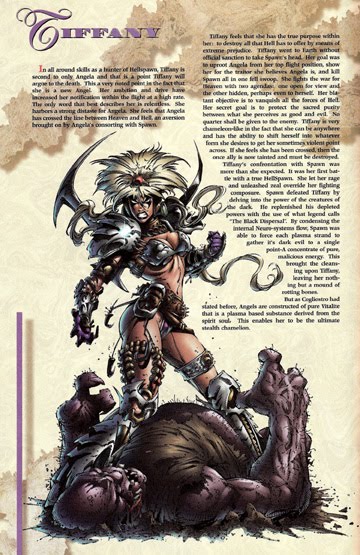
Arntsen showed an image of Tiffany from Spawn Bible (August 1996). [It's shown here along with the entry for Angela in the same comic book.] Gaiman said, "That's a page of Tiffany, who's another one of the warrior angels: sharp shoulder points and blonder and sort of hair that goes up and explodes, rather than goes down, but there's sort of long hair around the back. Same knee things, same loincloth and thong and big belt and heavy shoulderpiece. And also the weaponry." Asked to compare that drawing of Tiffany to the drawing of Angela for Spawn #9, Gaiman said, "Similar pose, very similar character. Again, the hair color is very different, and Angela has sort of the Viking wings as a headpiece, which Tiffany doesn't. But they're obviously very similar characters. The facial thing - the sort of masky face thing - is the same, and the style is the same."

Next

Read more...

  © Blogger template The Professional Template II by Ourblogtemplates.com 2009

Back to TOP