Showing posts with label Angela. Show all posts

Gaiman v. McFarlane 2010: It Is Ordered ...

Saturday, July 31, 2010

[This is part of my running report on the 2010 hearing on the Neil Gaiman v. Todd McFarlane case. To see coverage from the beginning, click here. For additional historical perspective, check out The Comics Chronicles' look back on Spawn #9 and the sales impact the "guest-author" issues had on the series.]

Part Twenty-Five Senior U.S. District Judge for the 7th Circuit Court for the Western District of Wisconsin Barbara B. Crabb announced her decision on July 29: "IT IS ORDERED that plaintiff Neil Gaiman's motion for an order to compel discovery relating to the money earned from derivative characters Dark Ages (McFarlane) Spawn, Domina and Tiffany is GRANTED. Defendants Todd McFarlane, Todd McFarlane Productions, Inc. and TMP International, Inc. are to produce the requested information promptly and in no event later than September 1, 2010."

The decision came in Case #02-CV-48-BBC, Neil Gaiman, Marvels & Miracles LLC vs. Todd McFarlane, Todd McFarlane Productions, TMP International and Image Comics. It had been determined that Neil Gaiman had been co-creator with Todd McFarlane of Spawn #9 and, with that issue, the characters of Count Cogliostro, Medieval Spawn, and warrior angel Angela. The current suit involved the ownership of characters that had appeared over the years in McFarlane's "Spawn" titles, specifically "Dark Ages Spawn" and warrior angels "Tiffany" and "Domina."

In her opinion, Crabb wrote, "The parties agree that they are co-owners of Angela and Medieval Spawn. Defendants do not contest plaintiff's right to an accounting and division of profits for the posters, trading cards, clothing, statuettes, animated series on HBO, video games, etc. that feature those characters. The dispute is limited to information about the profits earned from Dark Ages Spawn, Tiffany and Domina, which defendant has refused to provide to plaintiff. Defendants contend that these characters are not subject to plaintiff's copyright because they were based solely on plaintiff's ideas and not on any physical expression of those ideas. I conclude that the newer characters are derivative and that plaintiff is entitled to his share of the profits realized by these characters and to the immediate production of all documents and other information material to the calculation of the profits."

Her opinion noted some of the details of the storylines. For example, "The Dark Ages (McFarlane) Spawn is [like Medieval (Gaiman) Spawn] a twelfth century knight, referred to as The Black Knight, killed in a holy crusade far from his homeland and returned to Earth as Hellspawn. (In the first issue in which he is introduced, he is described as having been born in 901, tr. exh. 26, inside front cover; in future issues and in advertising for the comics and his action figure, he is described as having been born in the twelfth century.)"

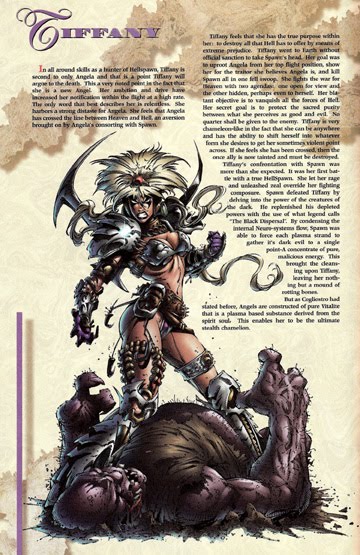
She summarized the appearance of the angel characters: "Tiffany and Domina are visually similar to Angela and share her same basic traits. All three are warrior angels with voluptuous physiques, long hair and mask-like eye makeup. all three wear battle uniforms consisting of thong bikinis, garters, wide weapon belts, elbow-length gloves and ill-fitting armor bras." She compared the two Spawns of the middle ages: "Defendant argues that when the court disregards the elements of Medieval (Gaiman) Spawn that are derived from the original Spawn and the stock elements that accompany a person of aristocratic lineage in the middle ages, such as traveling on horseback, wearing armor and carrying a weapon, every other aspect of Dark Ages (McFarlane) Spawn is new and different from Medieval (Gaiman) Spawn. It is true that Dark Ages (McFarlane) Spawn and Medieval (Gaiman) Spawn differ slightly in their backgrounds, but these are elements of their characters that make them individually copyrightable, not ones that prevent Dark Ages (McFarlane) Spawn from being found derivative. It is more significant that Dark Ages Spawn has the distinctive look of Medieval (Gaiman) Spawn that would cause any reader, casual or constant, to see a substantial similarity between them." She went on to discuss the basic concept of the series, then wrote, "Much as defendant tries to distinguish the two knight Hellspawn, he never explains why, of all the universe of possible Hellspawn incarnations, he introduced two knights from the same century. Not only does this break the Hellspawn 'rule' that Malebolgia never returns a Hellspawns [sic] to Earth more than once every 400 years (or possibly every 100 years, as suggested in Spawn, No. 9, exh. #1, at 4), it suggests that what defendant really wanted to do was exploit the possibilities of the knight introduced in issue no. 9. (This possibility is supported by the odd timing of defendant's letter to plaintiff on February 14, 1999, just before publication of the first issue of Spawn: The Dark Ages, to the effect that defendant was rescinding their previous agreements and retaining all rights to Medieval (Gaiman) Spawn.)"

She then elaborated with concepts of her own, not expressed during the June 14 testimony: "If defendant really wanted to differentiate the new Hellspawn, why not make him a Portugese explorer in the 16th century; an officer of the royal Navy in the 18th century, an idealistic recruit of Simon Bolivar in the 19th century, a companion of Odysseus on his voyages, a Roman gladiator, a younger brother of Emperor Nakamikado in the early 18th century, a Spanish conquistador, an aristocrat in the Qing dynasty, an American Indian warrior or a member of the court of Queen Elizabeth I? It seems far more than coincidence that Dark Ages (McFarlane) Spawn is a knight from the same century as Medieval (Gaiman) Spawn."


Spawn the Dark Ages Number 1 Cover A (Devils Knight)She wrote that it was irrelevant whether Spawn: The Dark Ages writer Brian Holguin had tried to base his Dark Ages (McFarlane) Spawn on Medieval (Gaiman) Spawn. "... what is relevant is that he had access to Medieval (Gaiman) Spawn before he created his version of the middle ages knight." She cited earlier court decisions including the 1977 case decision "holding that George Harrison had access to tune he used for 'He's So Fine'; therefore, even if copying was subconscious, it amounted to infringement." "The small differences in the two knights do not undermine a finding of derivation ... It is not, as defendent claims, a simple borrowing of an idea but a borrowing of the expression of ideas of the copyright owners. It would be considered infringing if it had been developed by anyone not working for defendent." She said the same applied to the other angels. "Certainly they are similar enough to be infringing if they had been produced and sold by someone other than the copyright owners. The totality of their attributes and traits, that is, their visual appearance, their costumes, their manner of speaking, their activities and their common origin (Heaven's angelic phalanx), mark them as derivative of Angela."

Next

Read more...

Gaiman v. McFarlane 2010: Post-Hearing Briefs in Brief

Monday, July 12, 2010

[This is part of my running report on the 2010 hearing on the Neil Gaiman v. Todd McFarlane case. To see coverage from the beginning, click here.]

Part Twenty-Three Following the June 14 evidentiary hearing, attorneys for Neil Gaiman and Todd McFarlane filed post-hearing briefs running more than a dozen pages each in support of their respective positions. In the words of the McFarlane attorneys, "The issue this Court is being asked to decide is whether Neil Gaiman is entitled to a share of profits attributable to characters known as Dark Ages Spawn, Tiffany and Domina. ... In the accounting process, there is no dispute that Mr. Gaiman is entitled to a share of profits from the comics in which the characters Medieval Spawn or Angela appeared or from derivative uses of those characters, such as action figures created of those characters. Mr. Gaiman now argues that he is entitled to a share of profits from other characters ... Mr. Gaiman's theory is that these other characters - Dark Ages Spawn, Tiffany and Domina - are derivative of the co-owned characters." In the words of the Gaiman attorneys, "The visual and literary similarities between the characters are far too striking to be brushed off as coincidences or merely similar 'ideas.' Under the law, a character is derivative if it would be an infringement when used by an unauthorized party. ... There can be no question that if anyone else had created comics using Tiffany, Domina, or Dark Ages Spawn, the McFarlane Defendants would have sued them for infringement of their copyrights in the Angela and Medieval Spawn characters, and won."

Each group of attorneys detailed the arguments for their side, citing testimony given during the June 14 hearing. Tomorrow, presumably before Judge Crabb announces her decision, I'll cite the lessons I have learned from all this. Then, we'll wait for the decision.

Next

Read more...

Gaiman v. McFarlane 2010: Testimony Wraps Up

Sunday, July 11, 2010

[This is part of my running report on the 2010 hearing on the Neil Gaiman v. Todd McFarlane case. To see coverage from the beginning, click here.]
 
Part Twenty-Two The hearing had begun at 9 a.m. It was now somewhere near 2 p.m. McFarlane was his own final witness, and his attorney Alex Grimsley asked him to compare the angel Tiffany (above), introduced in Spawn #44 (March 1996, written by McFarlane, pencilled by Tony Daniel, inked by Kevin Conrad) to the angel Angela (below), introduced in Spawn #9 (March 1993, written by Gaiman, drawn by McFarlane, here shown from Angela #3 (February 1995), pencilled by Greg Capullo and inked by Mark Pennington). McFarlane said they had the same marking around the eyes - but added that that had been a pre-existing element.
* "Angela has a spear, and Tiffany has a gun."
* "The hair is not the same."
* "Tiffany's wings are steel." He compared her wings to ninja blades.
* "Angela never had wings on her back."
When Grimsley referred to the entry on Tiffany in Spawn Bible, McFarlane said, "I don't believe I wrote that." Had McFarlane drawn the angel Domina? "I don't believe so."

Turning to the series Spawn: The Dark Ages, Grimsley asked why McFarlane had produced it. (It ran 28 issues, starting with the March 1999 issue and ending with the issue dated July 2001.) McFarlane answered, "I wanted to put more comic books out." Did he direct the team producing Spawn: The Dark Ages to base it on a specific time period? "I don't recall specifying," he said, adding that he'd told the team to "come up with something cool."

Gaiman attorney Allen Arntsen began the cross-examination. "Neil Gaiman created both Medieval Spawn and Angela in Spawn #9, right? "Right." "Angela was the first bounty-hunter angel?" "Right." "Angela is in the related story in Spawn #26, right?" "Correct, two or three pages, yeah." "Neil wrote Angela #1-3?" "Correct." "She's a major player in the Spawn universe?" "Correct. If I said it, I'll stand by it." Arntsen turned to the matter of whether there had been multiple Spawns in medieval times: "every 400 years, right?" "There may have been a time when that was true." Arntsen cited the letters page response in Curse of the Spawn #4 (December 1996): "A new Spawn appears on earth every 400 years and Daniel Llanso [the Spawn of Curse of the Spawn] is the Spawn that shows up 400 years after Al Simmons." Following an afternoon break, Arntsen returned to the 400-year plot device. McFarlane responded, "We weren't terribly consistent, and it wasn't a rule."

Questioning ended with a return to McFarlane attorney Grimsley: "How familiar are you with Spawn: The Dark Ages stories?" "Not very familiar." Regarding the 400-year basis? "We weren't consistent." "Why would you not be consistent?" "Things happen. I couldn't even keep track of how many spikes were on the costume." "Why not keep to the rules you set out?" "You break those rules because of the wants of the fans and marketing."

The session ended with attorneys agreeing to see to it that Judge Barbara Crabb received both attorneys' post-hearing briefs and (because some of the photocopies supplied to her as evidence had been virtually illegible) a set of exhibits in color by June 25.

Next

Read more...

Gaiman v. McFarlane 2010: Marketing and Angela's Design

Saturday, July 10, 2010

[This is part of my running report on the 2010 hearing on the Neil Gaiman v. Todd McFarlane case. To see coverage from the beginning, click here.]

Part Twenty-One Todd McFarlane discussed the economics of the comic-book and toy businesses briefly. Regarding the toys, he said, "The Spawn line as a whole was successful out of the gate, [produced] to draw on the popularity of Spawn." He addressed the issue of the Previews catalog listing for Spawn: The Dark Ages #1. "This is the main way you market to retailers." He said the solicitation did not mention Medieval Spawn. "We can make stuff look like other stuff and give it consistency. You call attention to the things that will get you sales. [In this case] the value is Spawn. ... If the intent was for us to use Medieval Spawn, we would have called him 'Medieval Spawn.' We weren't trying to do that."

Spawn #9 by Gaiman and McFarlane introduced Angela. "Were there elements of Angela used from Spawn?" Yes." He elaborated on his approach to drawing. "We have a flat piece of paper. We create the illusion of 3-D using cape, wind, and hair." He cited similarities to Spawn:
* Marks on her face are a repetition of the marks on Spawn's face, with the black indicating a bad guy.
* Blank eyes [since she's not a devil, her eyes aren't green]
* Her symbol is the opposite of the Spawn mark
* Her earrings are based on the Spawn mark
* "There are sharp points on Spawn, so she's got sharp points."
* "She's an angel, but wings locked on the back don't work [artistically], so they're on her head" (like Valkyrie headdresses)
* The chains of Spawn are turned into ribbons and even her hair

"Why is Angela scantily clad?" "A couple of obvious reasons: the history of women characters when men are at the helm." He cited paintings by Frank Frazetta and Boris Vallejo. "If we don't show skin, we put her in skin-tight clothes. Boys have been doing it since, I assume, the invention of boys."

Next

Read more...

Gaiman v. McFarlane 2010: Scantily Clad Angels

Monday, July 5, 2010

Batman: Whatever Happened to the Caped Crusader?[This is part of my running report on the 2010 hearing in the Neil Gaiman v. Todd McFarlane case. To see coverage from the beginning, click here.]
Part Fourteen Todd McFarlane's attorney Alex Grimsley asked whether Neil Gaiman had collaborated with other writers on a series. Gaiman said, "I did a book called The Children's Crusade which I ... wrote sort of book-ends and worked with a number of writers: Jamie DeLillo, Alisa Kwitney, Rachel Pollack, Nancy Collins, and many others. ... And ... my most recent comics work was a two-parter last year where I got to kill Batman." It was Batman: Whatever Happened to the Caped Crusader? - drawn by Andy Kubert. He described it as "the last Batman issue of Detective Comics and Batman Comics, and on that level you're kind of collaborating with 70 years of people who have written Batman and the people who are writing it now." However, Grimsley's next questions, which started with asking whether Pollack could have created an angel without being derivative of Angela, were objected to as calling for a legal conclusion, and the objections were sustained.

Grimsley turned to Spawn Bible and the page devoted to Tiffany: "Tiffany has ... on her right leg ... what appears to be like a little ammunition belt?" Gaiman responded, "I thought it was chocolates, but it could be ammunition. It could be anything." Grimsley asked, "Did you ever write anything or have any drawings where the angel used a gun?" "No." Grimsley showed another picture of Tiffany in which she was holding a gun. Gaiman said, "I don't believe somebody becomes less derivative of another character if they pick up a gun. Batman is still Batman if he's holding a gun." Grimsley went on, "And Tiffany has some sort of wing on her back. It looks like blades, correct?" "Yes." "She doesn't have the headpiece that Angela wore?" "No." "Both of these characters ... are, I guess to put it mildly, scantily clad?" "Yes." "Is it common in modern comic books to portray women scantily clad?" "Not the ones that I write." "OK, but putting aside the hadful that you write, is it fairly common?" "No." "No?" Gaiman said, "I was the editor this year of Year's Best American Comics and I read an awful lot of comics and most of them had fully clad women. I will accept there may be some comics out there with scantily clad women, but, no, I don't believe it's the norm." Grimsley said, "Well, when we're using the adjective 'scantily clad,' do you consider Wonder Woman to be fully clothed or scantily clad?" Gaiman said, "I haven't read a Wonder Woman comic in 10 years. I have no idea what she's wearing currently. Throughout her history, it has moved backwards and forwards. At one point in the '60s and '70s, she was in a trouser suit. The costumes vary."

Grimsley referred to a copy of Previews and asked Gaiman to describe the purpose of Previews, which he did. Then Grimsley displayed a page and asked whether Gaiman would describe them as scantily clad or fully clad. [I've tried to locate this specific copy of Previews without success. I believe the first image was of the Image title C.H.I.X., which was dated January 1998. In fact, as far as I could determine, most of the pages he chose in these samplings were from the Image listings of such series as Savage Dragon, and at least one was a special "swimsuit issue."] "Of the ones on here," Gaiman said, "one of them appears to be wearing fishnet bondage gear. One of them looks like Power Girl, who is a Superman knockoff in a cape. And one of them is a weird manga thing. I'm not even sure if she's - what she's - wearing. Are they fully dressed? No, they're wearing spandex." After a further sampling, Gaiman said, "I can absolutely, utterly, with my hand on my heart, testify that the ladies in those pictures in those ads that you showed me weren't wearing very much - nor were the men. Beyond that, I think generalizing the comics is deeply problematic."

Grimsley returned to differences between Angela and Tiffany and discussed differences between hair styles and that the headdress of Domina isn't the same as that of Angela. Gaiman said, "There are lots of different headdresses."

Next

Read more...

Gaiman v. McFarlane 2010: Medieval Spawn's Backstory

Saturday, July 3, 2010

Part Twelve [This is part of my running report on the 2010 hearing in the Neil Gaiman v. Todd McFarlane case. To see coverage from the beginning, click here.] Discussing the backstory of Medieval Spawn, Neil Gaiman said, "There isn't a lot of opportunity on those eight pages [in which the character appeared in Spawn #9] for conversation. In my backstory in my head, I think he'd been probably around fighting for ... five or 10 years, but nobody had actually turned around at that point and said, 'This is actually what's going on. You are going to be in Hell's army, blah, blah, blah, blah, blah.' but he had ... still been going around doing a certain amount of good wherever he could and being noble, even though he was a Spawn. I seem to remember some line about how when Spawns were young they could still ... fight for good, and ... in the case of young and fighting for good, I take it that Spawn is still fighting for good 18 years after the comic started. So the print gives you 18 years at least."


Looking at Spawn #9, it may be instructive to look at the total dialogue of Medieval Spawn talking to Angela, written by Gaiman. The speeches were as follows: "Good day, sweet maiden. You are hurt." "Where is this ogre?" "You would not wish to see my face, sweet maiden. Your sister, you say ...? I also had a sister, beautiful and wise, whom I swore I would see married before I died." "I ... went away, for many years. When I returned, my sister was indeed married ... not to the man I would have chosen, alas. If we knew the future, well, what then?" "I no longer have a name." "I also am most strong and fearsome. You shall wait here." "Very well." "No wizard, fair one. Once I was a man ... a bad man ... Now ... I know not what I am. This cave ... How much further must we go?" "What magic is this?" "What ... What manner of creature are you?" and "I don't understand ..." That's the printed material under discussion at this point in the hearing.

Gaiman said, "He's just met her. She's going, 'Ah, I'm a damsel in distress. Something bad is happening there. What are you?' And he said, 'Well, I was a bad man; now, I could be anything.'"

Next

Read more...

Gaiman v. McFarlane 2010: Spawn Bible and Spawn #8

Part Ten [This is part of my running report on the 2010 hearing in the Neil Gaiman v. Todd McFarlane case. To see coverage from the beginning, click here.] After a 15-minute recess, the hearing continued with Todd McFarlane's attorney Alex Grimsley beginning his cross-examination of Neil Gaiman. Grimsley referred to Spawn Bible (August 1996), whose credits were that the art was pencilled by Greg Capullo and inked by Danny Miki and Kevin Conrad and the entries were written by McFarlane, Beau Smith, Tom Orzechowski, and Andrew Grossberg. He asked Gaiman whether the page devoted to Angela summarized her "drives and personality." Gaiman responded, "The text is an adequate and fairly literate description by somebody else of the plot of Angela - of Spawn #9, and of Angelas #1 to #3. I don't know that I would agree with everything. I didn't write this." Asked whether there were parts with which he disagreed, Gaiman said, "The line 'Angela comes from Elysium, the first level of the Seven Heavens, closest to God' is not, for example, anything that I - You know, I just created Elysium. If Todd wants seven levels, he can add another six. That's fine." Asked whether he claimed co-creation of the idea of seven levels, Gaiman answered, "No. Alan Moore came up with the idea that there was seven levels of Hell in Spawn #8, and ... that was Alan's idea, and I imagine that is a reflection of the same thing done in angel terms." [In Spawn #8, a demon says his home is "the eighth sphere, some call it the Malebolge."] In any case, Gaiman agreed that the Spawn Bible description - though, "I would probably quibble with words all the way through it, but that's because I didn't write it" - was "a perfectly adequate description by somebody of the character in Spawn #9 and Angelas #1 to #3."


The questioning turned to "Medieval Spawn." "Medieval Spawn is another character you co-created?" "Yeah. I call him 'Olden Days Spawn,' I think, in this script, but Todd started calling him 'Medieval Spawn.'" "In the script, you actually think you named him something?" "He was Spawn. He was the Spawn of 800 years ago." Again, Grimsley referred to Spawn Bible, asking whether the "Medieval Spawn" entry was a fair description of the character Gaiman co-created. "It's an invented backstory, I guess," Gaiman said. "It could be - I didn't make any of that up, so that's not my - ... The story that I made up is the stuff right at the end and the stuff about the sister, which doesn't seem to be in there." The portion of description that he said was what he had created was, "... he was destroyed by Angela, without ever fully comprehending what he was." Gaiman said his creation had included providing thumbnails and drawings of the characters but he hadn't drawn any of the published images of the characters. "I described [Angela] in the script, but my co-creator had already had already given her a look." Regarding the Spawn of the Middle Ages, he said his script, "would have said ... it would be a medieval version of the Spawn costume or an armored version of the Spawn costume. I would have included the big Spawn shield, because that was on the cover."

The questioning turned to the issue that preceded Gaiman's: Spawn #8, drawn by McFarlane and written by Alan Moore. And, I discover with some shock, a fact I'd forgotten. It's "Dedicated To: Don & Maggie Thompson." My goodness! I remember now that we'd been touched and delighted at the time. But ... pause for a moment to grin. Then back to the hearing. Sorry for this self-indulgent interlude. Ahem. The story is titled "In Heaven (Everything Is Fine)." Gaiman said, "It's actually set in Hell. That's an ironic title." Grimsley noted the reference to an evolving neural parasite. Gaiman said, "Todd had asked Alan, and he mentioned to me, that he kept drawing the Spawn costume differently because he couldn't ever remember how many chains and spikes there were to be. So he was now getting letters from kids saying that the costume kept changing and could we come up with a rationale for why the costume was changing. So Alan came up with the idea, and I think we were talking about it, that ... the costume was a neural parasite and the costume was alive and it would keep the Spawn costume evolved and changed and responded and it wasn't actually a frozen thing."

Next

Read more...

Gaiman v. McFarlane 2010: Similar Angels

Thursday, July 1, 2010

Part Eight [This is part of my running report on the 2010 hearing in the Neil Gaiman v. Todd McFarlane case. To see coverage from the beginning, click here.] Arntsen turned to a comparison of the angels Gaiman had co-created with the angels involved in the Spawn storyline in #97 (July 2000) through #100 (November 2000). He quoted dialogue from a page in #99 (September 2000), which read, "By Elysium! The heavenly hosts!" and asked Gaiman, "What is that a reference to?" Gaiman responded, "Elysium was the place that they lived, and the heavenly hosts were the 333,000 kick-ass lady warrior angels." Asked, "Were those elements that you created?" Gaiman replied, "Yes." Going on to #100 and displaying one of the last pages, Arntsen asked, "Can you recognize what's being shown there?" "Spawn holding Angela's dead body while all of the other heavenly hosts of kick-ass lady warrior angels who look a bit like her stand around in the air." Arntsen then referred to images of other angels and asked Gaiman to describe similarities between Angela and Domina. "They are dressed incredibly similarly and they have the same facial stuff, very similar hair. Slightly different headpieces. I don't know, I would have assumed that this was one of the variant Angelas. ... Todd did a lot of Angelas in different costumes ... and changed the way she looked as a toy. I would have thought it was one of those." Gaiman was asked to describe another Domina picture that was in evidence, and he answered, "Same loincloth, things wrapped around the leg, weaponry, slightly different upper-body straps, but very similar costume."


Arntsen showed an image of Tiffany from Spawn Bible (August 1996). [It's shown here along with the entry for Angela in the same comic book.] Gaiman said, "That's a page of Tiffany, who's another one of the warrior angels: sharp shoulder points and blonder and sort of hair that goes up and explodes, rather than goes down, but there's sort of long hair around the back. Same knee things, same loincloth and thong and big belt and heavy shoulderpiece. And also the weaponry." Asked to compare that drawing of Tiffany to the drawing of Angela for Spawn #9, Gaiman said, "Similar pose, very similar character. Again, the hair color is very different, and Angela has sort of the Viking wings as a headpiece, which Tiffany doesn't. But they're obviously very similar characters. The facial thing - the sort of masky face thing - is the same, and the style is the same."

Next

Read more...

Gaiman v. McFarlane 2010: 333,000 Warrior Angels

Wednesday, June 30, 2010

Part Seven [This is part of my running report on the 2010 hearing in the Neil Gaiman v. Todd McFarlane case. To see coverage from the beginning, click here. When last I posted, I was in the midst of Neil's discussion of the creation of Medieval Spawn and the angel huntress Angela. I do hope that any reader who has begun with this installment will stop reading here and click on the link above in order to work his or her way chronologically to this point. I understand that Everyone these days knows how to read blogs in reverse order, but ...]


Later, Gaiman wrote three pages of Spawn #26 (December 1994) and a three-issue mini-series titled Angela (#1 December 1994; #2 January 1995; #3 February 1995) about the angel. "I did Angela ... because my son was 12 and he discovered the Spawn toys and things and wanted me to do something that he'd like, because most of the stuff I wrote was for adults in comics." Asked whether he'd expanded on Angela's world in the mini-series, he responded, "Sure ... part of the fun of it was creating this sort of huge backstory. ... you discover that she's 100,000 years old ... and there's an angelic host: There's 333,000 of these beautiful warrior angels and they're arresting her. She's in trouble right at the beginning. Part of the fun for me was creating ideas. If you're writing comics, what you always want to do is leave the ground more fertile than when you were there. You want to leave more stuff for people who are going to be writing ongoing series to play with, which is why it was fun for me giving Todd, for example, the idea that there had been lots of Spawns. It was something that left him with more than had been before. So with this, I created a heavenly city called Elysium. I created 333,000 warrior angels who all look like exotic dancers and named a few of them. And they all looked different. They all have certain very specific similarities: the masky thing around the eyes, for example, the fact that they are part of this order of kick-ass lady warrior angels." Asked if any of the angels were Domina or Tiffany, Gaiman said they weren't. His angels had such names as Surielle, Kuan Yin, Anahita, Saranyu, and Gabrielle. "I basically just took names of angels or gods or goddesses specifically from different cultures and gave them to the ladies. So, in the same way that Angela was fundamentally a joke name, it was also a very serious name. It's 'angel.' It's a name with 'angel' in it."

He summarized the mini-series. "She gets arrested for being a traitor, for having hunted Spawn without a license, even though she said she did have a license. ... The angels go and get Spawn to come and be a witness at her trial. She realizes she is being set up. She and Spawn escape from Heaven to Hell and have an awful lot of shouting, fighting, hitting, and running around. And then ... she essentially gets a confession out of Gabrielle, the lady who set her up, and Gabrielle gets arrested. Angela is given a pardon or exonerated but decides that she doesn't want to be working for Heaven any more, she wants to go freelance ... not actually directly taking orders from anybody else. She was just going to be out there on her own: kick-ass angel for hire."
Arntsen asked Gaiman to discuss whether he'd been involved in writing comic-book series that were produced over a long period of time. He responded, "The most famous one would be Sandman, which was a comic that I wrote that ran 75 issues. It's now collected in 10 volumes of paperbacks." The series appeared dated from January 1989 to March 1996. "In it, I created a lot of characters and I also used some DC Comics characters, and there were also some characters who were deemed derivative by DC Comics. When they worked up my royalty on them, some merchandising or some spinoffs happened." Asked if characters evolve over the course of a series, he replied, "Oh, sure. ... Characters change and character costumes change. ... The Batman of now does not wear the costume of the Batman of 1939, ditto Superman, ditto Wonder Woman. ... Morpheus, my character in Sandman: He dresses in lots of different ways, always chiefly wearing black and having ... longish coats or cloaks. But always - It's obvious the same character, it's obviously the same person, but you get different artists and they draw things differently. You decide to try things a different way."

Next

Read more...

Gaiman v. McFarlane 2010: Opening Statements

Sunday, June 27, 2010

Part Three [This is part of my running report on the 2010 hearing in the Neil Gaiman v. Todd McFarlane case. To see coverage from the beginning, click here.] Ed Treleven had posted May 25 a colorful account of the background of the case. Intriguingly, judging from her comments during the June 14 hearing, Judge Crabb had apparently not seen color exhibits before the hearing. Nor were the visual displays (screens at witness chair, lawyer tables, and judge's chair - fed from views from a horizontal platform not adjusted to show a vertical comic-book page) sharp enough to permit viewers to read some of the exhibits under discussion.

The opening statement by Arntsen's associate Jeff Simmons suggested three identifying factors to determine whether a character in comic books is derivative of or infringing on another character. "If it's a derivative character, it would be an infringing character, if somebody else, somebody who was not authorized to use it, used that character." He said courts typically use the character's backstory and, in the case of comics characters, that character's powers and the character's costume. He added a reference to Judge Posner's 2004 decision in McFarlane's appeal to the 2002 decision: "Judge Posner particularly said with regard to the Medieval Spawn character, you look at the way the character speaks. Judge Posner said, if he talks medieval and he looks medieval, then he infringes Medieval Spawn." Simmons said the judge should look for the same basic traits in the characters under discussion.

Grimsley opened by saying, "We believe the topic ... [is] more appropriate for jury trial." Crabb said she'd already ruled on that matter. He discussed what he called the difference between an idea and the expression of that idea, saying that, regarding the question of the idea of warrior angels, "Ideas cannot be the subject of copyright." He said that it had been agreed that McFarlane and Gaiman had co-created Medieval Spawn (a derivative of Spawn, already created by McFarlane) but that the copyright was limited to the additional elements. "There are elements in the design of Angela that are designed from the Spawn character. There are other elements of Angela, the female warrior, that are somewhat just generic to the comic industry, and in this respect you could go all the way back to Wonder Woman to see many of those elements." He argued that, if, say, similarities between angels Tiffany and Domina and Gaiman co-creation Angela mean the first two are derivative of the third, "essentially what Mr. Gaiman would be successful in arguing is that he has a copyright on the idea of the female warrior angel. And if Dark Ages Spawn is found sufficient to be derivative of Medieval Spawn and Mr. Gaiman is going to say the creative work that Mr. Holguin did was nothing more than copying his work, essentially Mr. Gaiman is saying, 'I have a copyright on the idea of a Hellspawn from medieval times.' The law is clear that those ideas cannot be the subject of the copyright, only the actual expression of those ideas."

Then, Gaiman took the stand.

Next

Read more...

  © Blogger template The Professional Template II by Ourblogtemplates.com 2009

Back to TOP