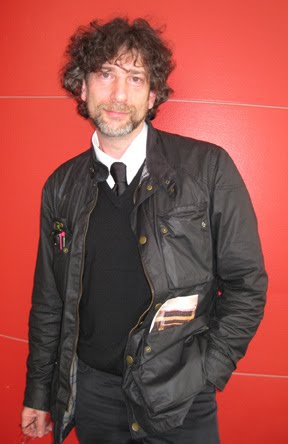
Gaiman v. McFarlane 2010: Neil Gaiman Begins His Testimony

Tuesday, June 29, 2010

Part Five [This is part of my running report on the 2010 hearing in the Neil Gaiman v. Todd McFarlane case. To see coverage from the beginning, click here.] Arntsen asked Gaiman to introduce himself, and he responded, "I'm a writer." He cited his comics, adult novels, and children's books and commented that he'd won Eisner, Hugo, Nebula, and Newbery Awards [and has, since his testimony, won the Carnegie Medal] and noted that the Coraline film (nominated for an Oscar) had been based on his novel.

How had he gone about creating for McFarlane? "Todd had ... asked me to write an issue of Spawn. ... He wanted celebrity writers. ... Todd ... had told me that I could write anything that I wanted. He said that I had complete carte blanche. If I wanted to do 23 page of Spawn reading a newspaper, I could." At that point, he said, McFarlane was working on #4 or #5 of Spawn, writing him as a warrior of Hell. "If you're a warrior of Hell," Gaiman said, "then you've got to be fighting something. So fighting Heaven seemed to make sense. And I thought, if you're warriors, you can't have nice angels, because you have to have somebody to fight - so, therefore, they have to be warrior angels. And thought, Why not make it a female character?
"So I called Todd and said, 'OK, this is the idea: female character, angel, talked him through it a little bit, and also asked Todd, 'Could there have been previous Spawns, because you haven't actually seen any previous Spawns at that time?' And he said he didn't see why not, as long as there weren't a lot of them. You couldn't have one every few years; they had to come along every hundred years or so. Because I thought, well, the best way to introduce a character who is going to fight Spawn is to actually show her killing a previous one of his predecessors, which establishes that she's the kind of person who does that kind of thing: kills Spawns."
The solicitation had to be ready before #9 shipped, so McFarlane drew a cover to accompany the solicitation. [It appeared in Diamond Comic Distributors' Previews catalog with the cover date of March 1993.] Gaiman explained the concept of the comics industry's solicitation process and then remarked on what McFarlane had drawn to accompany the solicitation: "I had to give Todd a little precis of what it would be, and he drew that cover - which wasn't exactly what I had in mind for the character. ... I thought when we were talking angels, we were probably talking something with more clothes. But I thought, Great, that's what we're given and that's kind of fun and, so, took the elements that Todd had created in there, the spear that he'd drawn. I thought, great, I'll play with that. So that ... was the first image." [The image appeared in the full-page ad, above, as well as in the solicitation itself.] "I'd come up with the idea of a character, she was going to be called Angela, and I did a little precis and a description for Todd of what was going to happen. He drew that image. I then took that image and made that the character that I was writing when I wrote the comic."
"Did you write the entire Spawn #9?"
"Yes."
"Were you aware of other characters like [this]?"
"There definitely hadn't been an army - as far as I know, anyway - ... an army of female kick-ass warrior angels, lady angels, who were also - who were hunters and merciless and not terribly nice. Because I thought, If Spawn & Co. are fighting these guys, then the other side needed to be almost as bad."
He commented that he was "making her a hunter ... somebody who just hunts these things and she has their heads on her wall."
As to "Medieval Spawn": "The idea was that there would have been a Spawn who was a knight in armor, and I had him essentially show up. I didn't have that many pages; it was one issue, so I came up with the idea of a Spawn who was a knight in armor. He shows up on his finely caparisoned horse. He has a shield, a sword, and a version of the Spawn costume that's essentially armor or something closer to what a knight in armor might wear or what a medieval knight would have worn. He shows up. ... I created a little backstory for him: the idea that he had been tricked by a devil; that his sister who he loved had - he returned from the dead to find that she had married his greatest enemy, somebody he hated, but he was still trying to be noble and knightly."

Next

Read more...

Gaiman v. McFarlane 2010: Revisiting October 3, 2002

Monday, June 28, 2010


Part Four [This is part of my running report on the 2010 hearing in the Neil Gaiman v. Todd McFarlane case. To see coverage from the beginning, click here.] Taking a breath before posting Neil's testimony in the 2010 case, I remind readers of what happened in 2002. Quoting myself from Comics Buyer's Guide #1510: "The Oct. 3 verdicts in Neil Gaiman v. Todd McFarlane brought victory on all counts to Gaiman, co-creator with McFarlane of Spawn #9 and, with that issue, the characters of Count Cogliostro and Medieval Spawn. Moreover, the copyright ramifications of the jury findings could mean that Gaiman can license those characters for use in crossovers with other comic-book publishers." Obviously, the intervening years have not brought such crossovers to comics shops - and I should have added the character Angela to that first sentence.

Next

Read more...

Gaiman v. McFarlane 2010: Opening Statements

Sunday, June 27, 2010

Part Three [This is part of my running report on the 2010 hearing in the Neil Gaiman v. Todd McFarlane case. To see coverage from the beginning, click here.] Ed Treleven had posted May 25 a colorful account of the background of the case. Intriguingly, judging from her comments during the June 14 hearing, Judge Crabb had apparently not seen color exhibits before the hearing. Nor were the visual displays (screens at witness chair, lawyer tables, and judge's chair - fed from views from a horizontal platform not adjusted to show a vertical comic-book page) sharp enough to permit viewers to read some of the exhibits under discussion.

The opening statement by Arntsen's associate Jeff Simmons suggested three identifying factors to determine whether a character in comic books is derivative of or infringing on another character. "If it's a derivative character, it would be an infringing character, if somebody else, somebody who was not authorized to use it, used that character." He said courts typically use the character's backstory and, in the case of comics characters, that character's powers and the character's costume. He added a reference to Judge Posner's 2004 decision in McFarlane's appeal to the 2002 decision: "Judge Posner particularly said with regard to the Medieval Spawn character, you look at the way the character speaks. Judge Posner said, if he talks medieval and he looks medieval, then he infringes Medieval Spawn." Simmons said the judge should look for the same basic traits in the characters under discussion.

Grimsley opened by saying, "We believe the topic ... [is] more appropriate for jury trial." Crabb said she'd already ruled on that matter. He discussed what he called the difference between an idea and the expression of that idea, saying that, regarding the question of the idea of warrior angels, "Ideas cannot be the subject of copyright." He said that it had been agreed that McFarlane and Gaiman had co-created Medieval Spawn (a derivative of Spawn, already created by McFarlane) but that the copyright was limited to the additional elements. "There are elements in the design of Angela that are designed from the Spawn character. There are other elements of Angela, the female warrior, that are somewhat just generic to the comic industry, and in this respect you could go all the way back to Wonder Woman to see many of those elements." He argued that, if, say, similarities between angels Tiffany and Domina and Gaiman co-creation Angela mean the first two are derivative of the third, "essentially what Mr. Gaiman would be successful in arguing is that he has a copyright on the idea of the female warrior angel. And if Dark Ages Spawn is found sufficient to be derivative of Medieval Spawn and Mr. Gaiman is going to say the creative work that Mr. Holguin did was nothing more than copying his work, essentially Mr. Gaiman is saying, 'I have a copyright on the idea of a Hellspawn from medieval times.' The law is clear that those ideas cannot be the subject of the copyright, only the actual expression of those ideas."

Then, Gaiman took the stand.

Next

Read more...

Gaiman v. McFarlane 2010: The New Spawn Case


Part Two [This is part of my running report on the 2010 hearing in the Neil Gaiman v. Todd McFarlane case. To see coverage from the beginning, click here.] Judge Crabb is a Senior U.S. District Judge for the 7th Circuit Court for the Western District of Wisconsin. The 2002 case had been a jury trial presided over by Senior Judge John C. Shabaz, who has since retired. It had determined that Neil Gaiman had been co-creator with Todd McFarlane of Spawn #9 and, with that issue, the characters of Count Cogliostro, Medieval Spawn, and warrior angel Angela. The case had been appealed in 2004 and its decision upheld February 24, 2004, by Circuit Judges Richard A. Posner, Michael S. Kanne, and Ilana Diamond Rovner. Gaiman's lead attorney this time, as in 2002, was Allen Arntsen. McFarlane's lead attorney was J. Alex Grimsley. And the current suit involved the ownership of characters that had appeared over the years in McFarlane's "Spawn" titles, specifically "Dark Ages Spawn" and warrior angels "Tiffany" and "Domina." Gaiman (on the left) was the only witness for the plaintiff (Gaiman); writer Brian Holguin and McFarlane (left and right on the right) were the two witnesses for the defendent (McFarlane).

Next

Read more...

Gaiman v. McFarlane 2010: It Begins

Part One [This is the first part of my running report on the 2010 hearing in the Neil Gaiman v. Todd McFarlane case. For additional historical perspective, check out The Comics Chronicles' look back on Spawn #9 and the sales impact the "guest-author" issues had on the series.]

In May, my buddy Jon Manzo had alerted me to the fact that there was going to be some sort of hearing in Madison, Wisconsin, on June 14, 2010, regarding legal matters concerning Todd McFarlane and Neil Gaiman. I noted that in passing and eventually decided that I wanted to stay up to date in such matters, since I'd covered the October 2002 case Neil Gaiman v. Todd McFarlane in Comics Buyer's Guide #1510 and #1511.

My deep understanding of legal matters led me to think that the current case would probably consist of about an hour's worth of lawyers making motions, after which everyone would scatter. Indeed, when I entered the Robert W. Kastenmeier United States Courthouse, among the first people I encountered was Ken Levin, whom I think I'd first met in the 2002 case. Also among folks in the lobby was the aforementioned Jon. So lawyers were, indeed, on hand - and then I stepped into the elevator and there was Todd. Entering Courtroom 260, it was almost deja vu: Neil was with his lawyers at the plaintiff's table.

It was Case #02-CV-48-BBC, Neil Gaiman, Marvels & Miracles LLC vs. Todd McFarlane, Todd McFarlane Productions, TMP International and Image Comics. And I began to take notes. (How many notes I took may be indicated by just how long it's taken me to write this, which is only the beginning of what should be several posts.)

Next

Read more...

  © Blogger template The Professional Template II by Ourblogtemplates.com 2009

Back to TOP